Loading...
SAKAI Ayano
Zero2Entrepreneur Portfolio

SAKAI Ayano

Contribution activity

18 contributions in the last year

Submissions, reviews, and documented work

Nov Dec Jan Feb Mar Apr May Jun Jul Aug Sep Oct Nov
Mon Wed Fri
Less More

About Me

堺 彩乃 · Faculty of Engineering — Civil & Environmental Engineering · 工 工 社会基盤工学 · Year 1

4
Submissions
3
Evaluations
1
Fully reviewed
4.5
Avg score

Course submissions

Every submitted session, with the date it was turned in and when it was evaluated.

Session Work Date submitted Evaluation date Reviews
Session 1 Name Problem Prediction Sep 30, 2026 Oct 19, 2026 2/2 avg 5
Session 2 Field Notes & Empathy Canvas Oct 20, 2026 Oct 21, 2026 1/2 avg 4
Session 3 Subculture: Problem Statement & Canvas Oct 24, 2026 Pending 0/2
Session 4 Solution & 6-Slide Pitch Nov 8, 2026 Pending 0/2
Session 1

Name Problem Prediction

Reviews complete
Date submitted
Sep 30, 2026 5:10 AM UTC
Evaluation date
Oct 19, 2026
Peer reviews
2 of 2 · avg 5/5
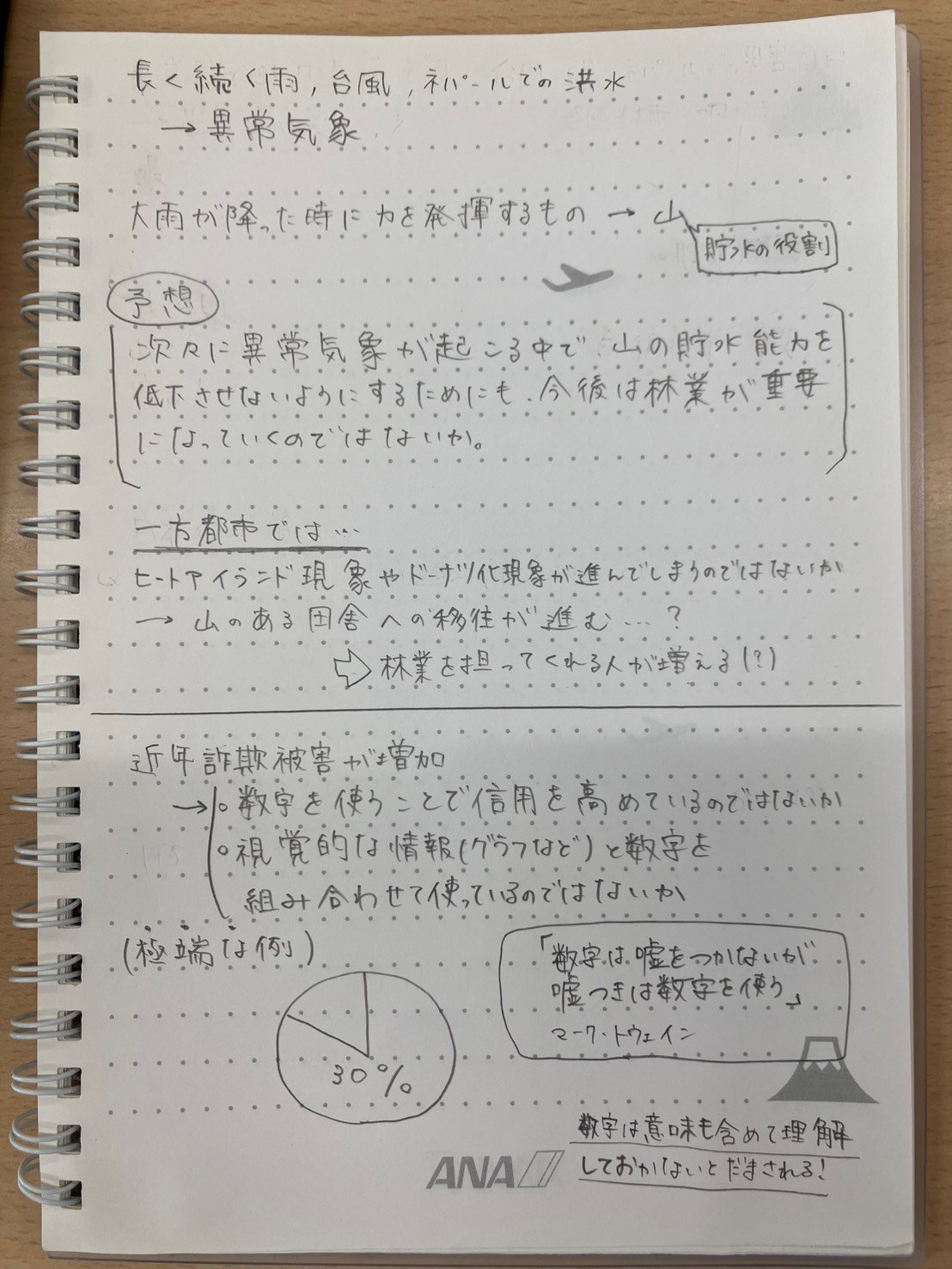
What do you predict, and why?

Three related issues ・Extreme weather causes heavy rainfall, leading to related disasters. ・Aging of forests, aging of the forestry workforce, and labor shortages ・The heat island phenomenon caused by the covering of the ground surface with asphalt or concrete in urban areas and elsewhere. Forestry is expected to expand as a measure against heavy rainfall caused by extreme weather. Reason The water-retention capacity of mountains becomes crucial during heavy rainfall. However, the forestry workforce is aging, and the number of young people ready to take on the next generation of forestry work is declining. Furthermore, since many Japanese mountains feature steep slopes that make mechanized operations difficult, human management is indispensable. Meanwhile, urban areas are experiencing the "heat island" phenomenon caused by ground surfaces being covered in asphalt and concrete. Consequently, I predicted that in the future, people seeking cooler environments might migrate to mountainous regions, thereby increasing the pool of available forestry personnel.
Evaluations
Review 1 · 5/5
Oct 19, 2026 12:15 PM UTC
Review 2 · 5/5
Oct 19, 2026 1:47 PM UTC
Session 2

Field Notes & Empathy Canvas

Awaiting reviews
Date submitted
Oct 20, 2026 7:01 AM UTC
Evaluation date
Oct 21, 2026
Peer reviews
1 of 2 · avg 4/5
Interview three more people about challenges with the education system. Write what you heard (facts and statements), not your interpretation.

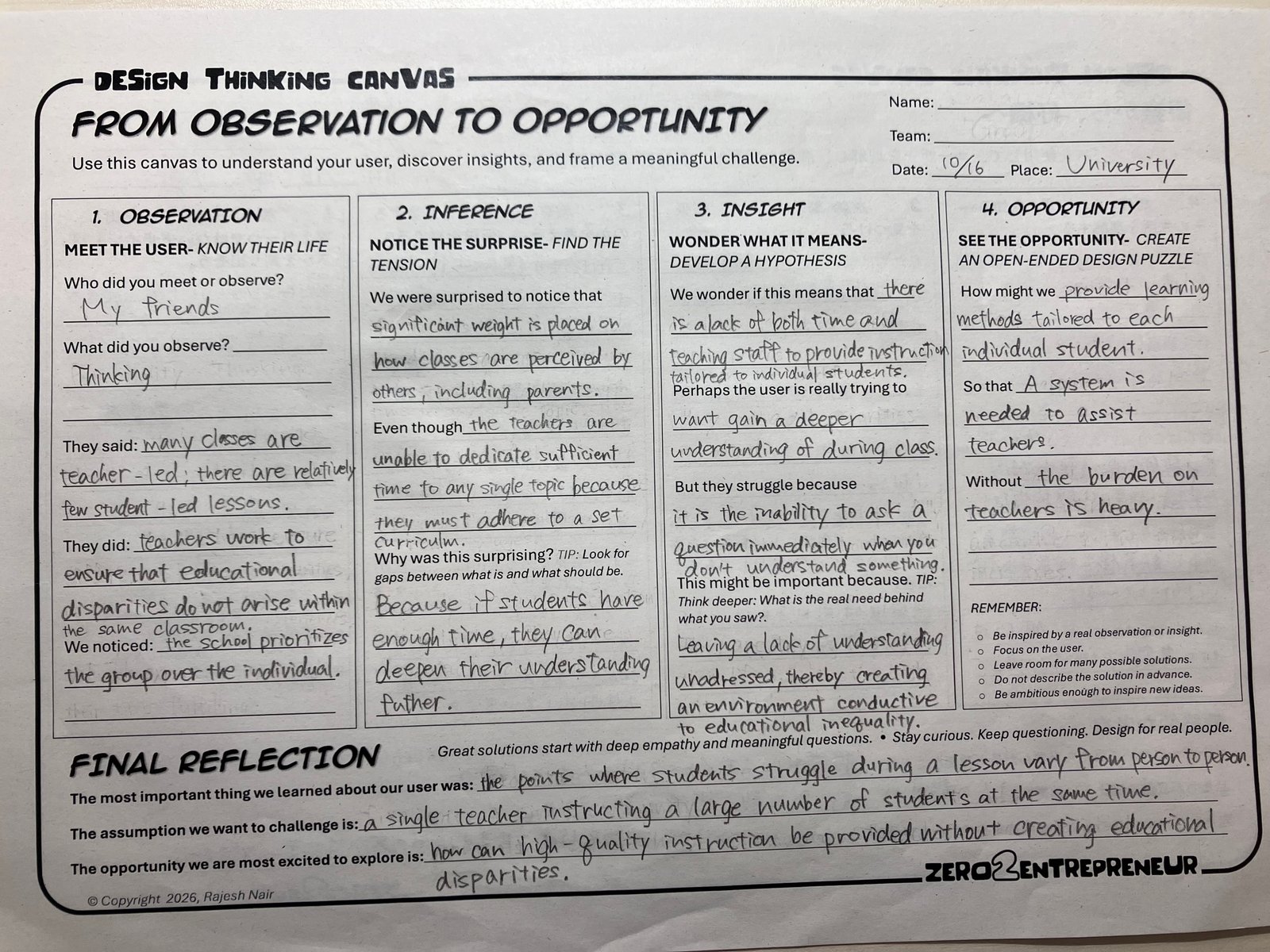
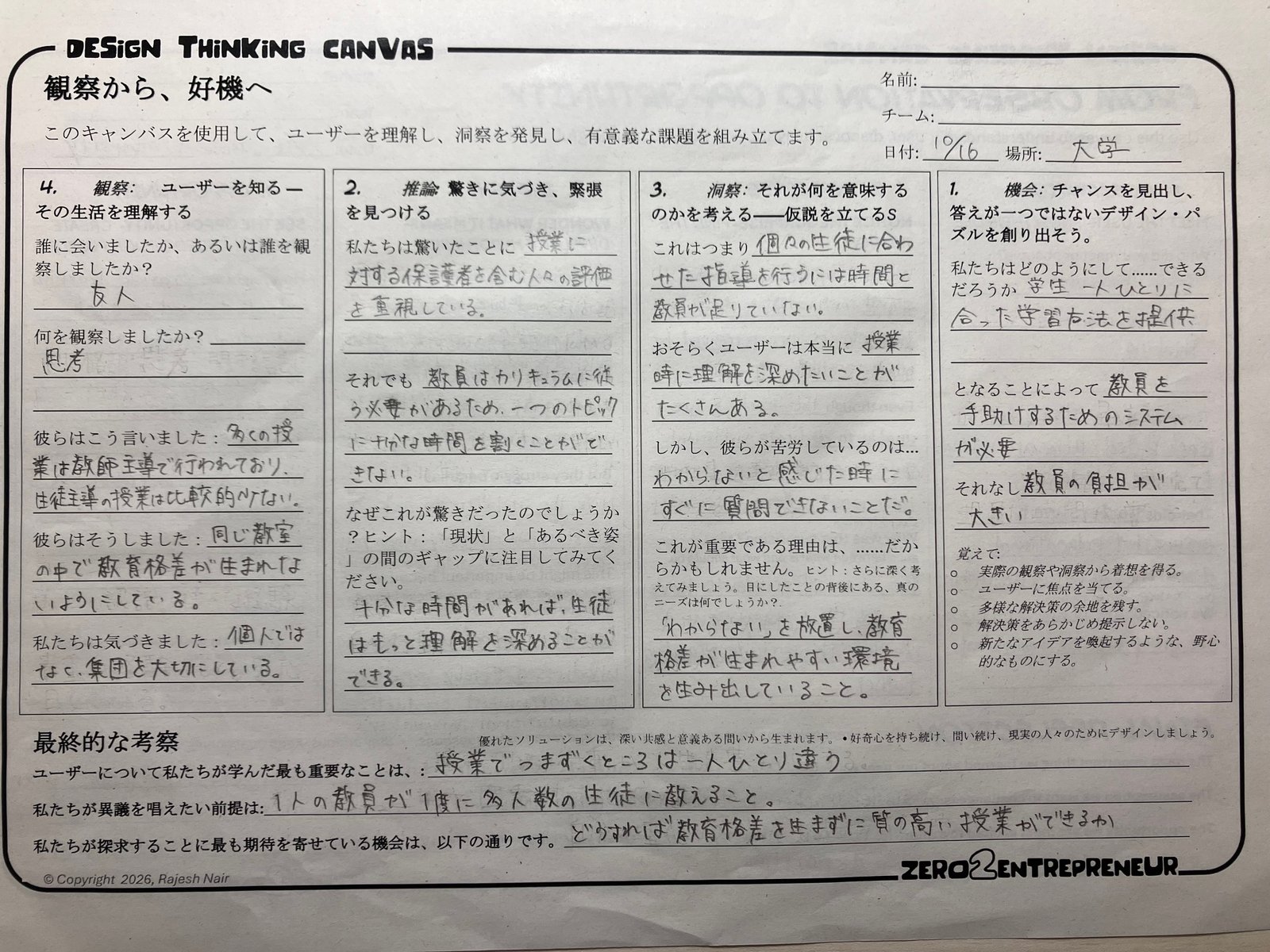
・Many classes are teacher-led; it cannot be said that many are student-led. ・In an effort to avoid overburdening teachers, the things students want to do are being restricted. ・Increase in school absenteeism ・ Significant weight is placed on how classes are perceived by others, including parents. ・It is difficult to provide instruction tailored to each individual student in a way that prevents educational disparities from emerging within the same class. ・Due to the need to adhere to the curriculum, it is not possible to dedicate much time to any single topic.

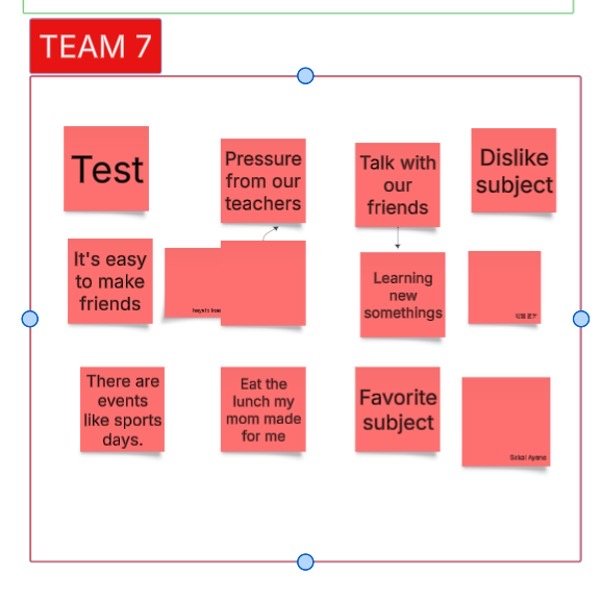
Fill your Lucid frame for your team with observations. Describe what you added, and include the Lucid link if you have one.

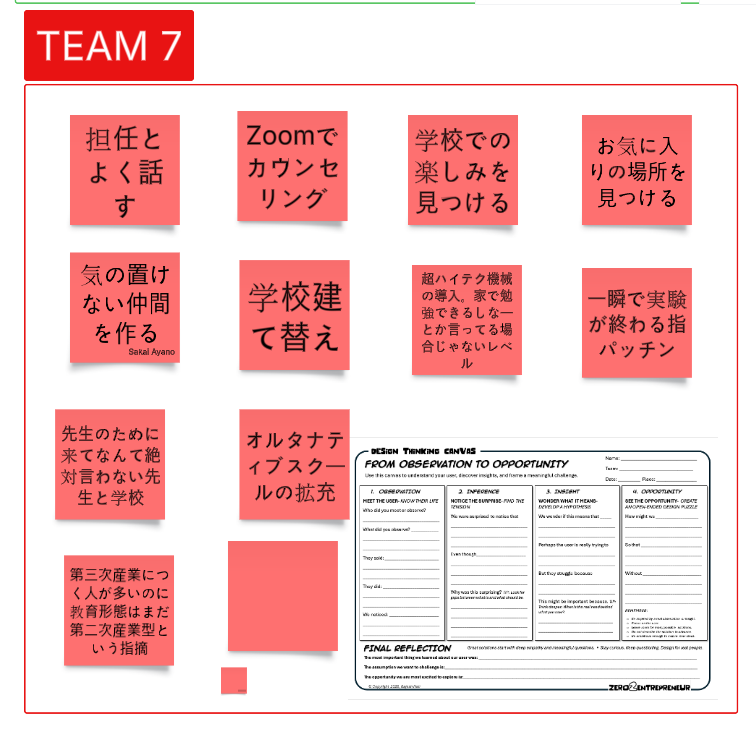
Points regarding challenges within the Japanese education system were raised. It was noted that, compared to other countries, Japan has fewer student-centered lessons, and that the scale of extracurricular activities is being reduced—partly to alleviate the burden on teachers—which may be preventing students from pursuing their own interests to a satisfying degree. Furthermore, the recent rise in the number of students who stop attending school—finding themselves in a situation where they "want to go but cannot"—was highlighted as a significant issue. Lucid URL https://lucid.app/lucidspark/606a1b2b-9c46-42eb-8977-2d3f47671723/edit?invitationId=inv_b37866f5-89c6-4aad-9cfb-d3c4952d0168&page=0_0#

Identify one problem from your engagements. Who is facing what challenge, and why does it matter?

It is difficult to provide instruction tailored to each individual student in a way that prevents educational disparities from emerging within the same class. When teachers dedicate time to providing individual instruction to each student, it is time-consuming and places a heavy burden on the teachers. However, not all students can grasp the material through the same instructional approach. Consequently, unless this challenge is addressed, the content that teachers are expected to convey to their students may fail to be effectively communicated.

Fill out the Empathy Canvas. Summarize it here and add a photo or link to the canvas.

In schools, instruction is often designed with the group in mind rather than the individual. Since the points at which students struggle to understand the material vary from person to person, shouldn't we strive to create an environment that minimizes educational disparities—for instance, by increasing the number of teachers or allocating more time to specific topics to help deepen student understanding?

https://lucid.app/lucidspark/606a1b2b-9c46-42eb-8977-2d3f47671723/edit?invitationId=inv_b37866f5-89c6-4aad-9cfb-d3c4952d0168&page=0_0#

Evaluations
Review 1 · 4/5
Oct 21, 2026 12:25 PM UTC
Session 3

Subculture: Problem Statement & Canvas

Awaiting reviews
Date submitted
Oct 24, 2026 7:56 AM UTC
Evaluation date
Pending
Peer reviews
0 of 2
Discuss with your team and finalize the problem statement. Write the statement clearly: who is facing what challenge, in what situation, and why it matters.

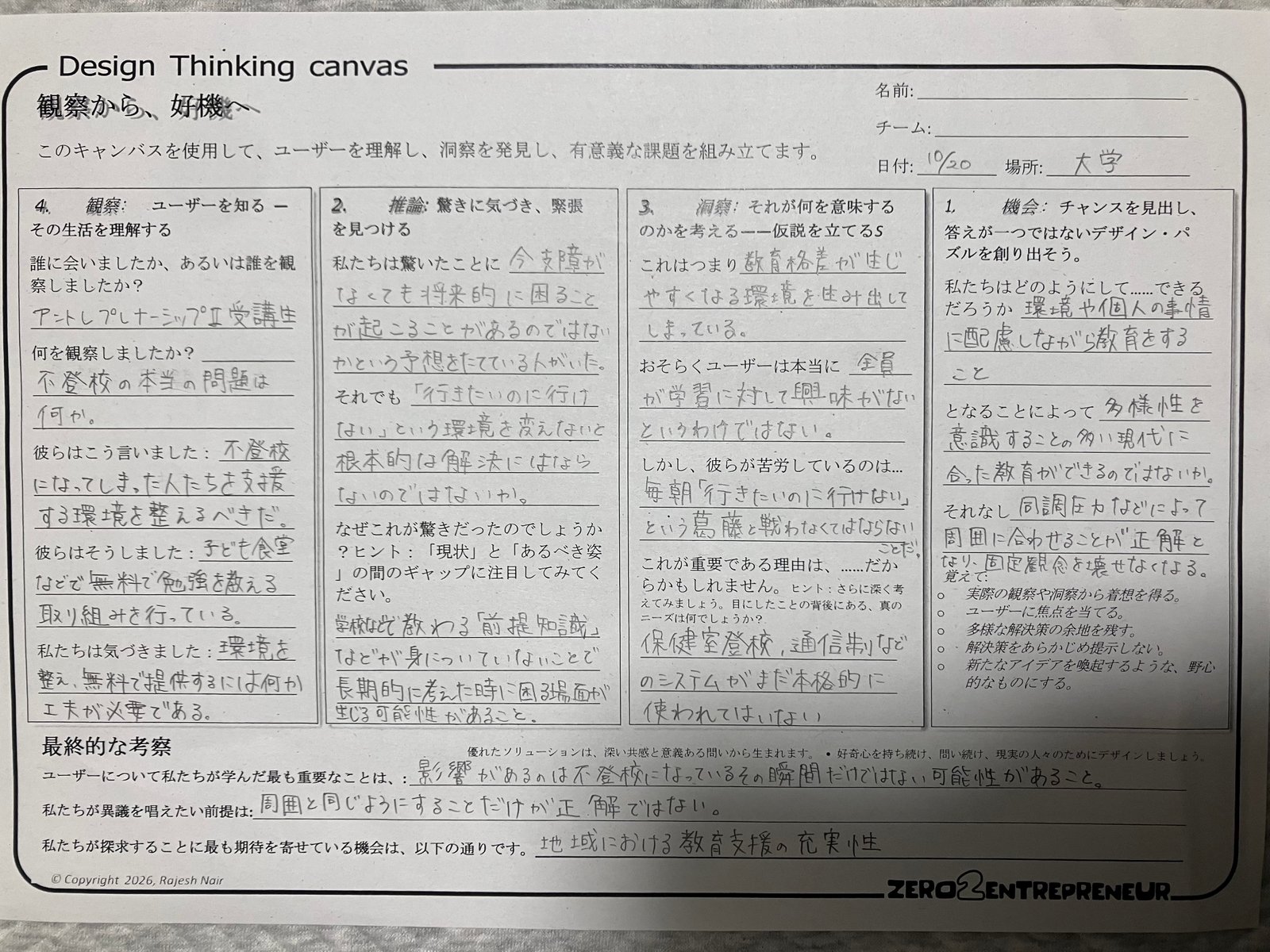
What is the real issue behind school absenteeism? In recent years, an increasing number of children and students have stopped attending school due to complex underlying factors, including psychological and social issues. These individuals often face an internal conflict every morning: they want to go to school, yet find themselves unable to do so. Various support systems exist for those who have stopped attending, such as the option to spend the school day in the nurse’s office or enrolling in correspondence-based schools. The Ministry of Education, Culture, Sports, Science and Technology (MEXT) has emphasized that addressing the issue of school non-attendance requires a collaborative effort from society as a whole; for instance, some local community-run "children’s cafeterias" (*kodomo shokudo*) now offer academic tutoring for students who are unable to attend school. However, providing such services free of charge remains a challenge in terms of funding. This issue extends beyond the need for immediate support; it becomes increasingly serious when one considers the future. Even if there are no apparent difficulties at present, there is a risk that a student may fail to acquire the foundational knowledge or social norms necessary for future learning. In today’s society—which emphasizes the importance of respecting diversity—the educational disparities that arise from school absenteeism represent a critical challenge that must be addressed as early as possible.

Fill in your Canvas with your observations and insights. Summarize what you added, and include a canvas link or photo.

In recent years, the number of children and students who stop attending school has been on the rise. While social collaboration—such as community-based learning support—is expanding, scaling these initiatives requires overcoming financial challenges to ensure they can be sustained without cost to the participants. This issue goes beyond the immediate need for support; it carries the risk of creating educational disparities, as those who miss out on schooling may lack essential knowledge and social skills later in life. In today’s society, which values ​​diversity, the emergence of educational gaps stemming from school non-attendance is a critical issue that must be addressed as a matter of urgency.

Session 4

Solution & 6-Slide Pitch

Awaiting reviews
Date submitted
Nov 8, 2026 11:19 PM UTC
Evaluation date
Pending
Peer reviews
0 of 2
Discuss with your team and finalize the Solution. Write the solution clearly: what you will do, for whom, and why this approach.

Solution: Introduce a new AI platform in school classrooms that combines "high-tech" capabilities with the philosophy of alternative education. ■ Target Audience Students who feel stifled or isolated in the classroom due to the friction of everyday interpersonal relationships or the pressure to conform to a "norm." ■ Implementation Develop and deploy a "two-tiered AI platform" utilizing one-to-one student devices. Private Tier: Synchronized with the teacher’s lesson progress, this tier provides a secure, private space for individualized learning support and dialogue, where students can document their trial-and-error process in a "thought portfolio." Public Tier: An AI agent resides within the shared classroom space to facilitate learning and provide support with assignments. (Designed not as a "perfect, model student," but as an approachable, "socially oblivious" character, the AI ​​helps lower the psychological barriers between students and teachers.) ■ Rationale Rather than replacing teachers, this approach uses technology to create "psychological breathing room" within a classroom structure often defined by constant evaluation. By introducing an intentionally "clumsy" AI, the tension is eased, fostering an environment where students can ask questions and express themselves without the fear of failure. This fundamentally addresses the underlying atmosphere that often contributes to school absenteeism.

Create a 6-slide pitch covering: Your Team, Problem Definition, Problem Analysis (What, Why, Who, When, and How), and Solution Approach. Summarize the slides here.

This proposal outlines a new platform that integrates "AI technology" with the philosophy of "alternative schooling" to alleviate the stifling atmosphere and pressure within classrooms—factors often contributing to school absenteeism. By addressing the rigid teacher-student dynamics and the competitive, evaluation-driven nature of traditional school environments, this system creates "breathing room" for students through two distinct approaches: Features for individuals: Providing a secure, private one-on-one space for learning support and the documentation of one's own thought processes. Features for the collective: Utilizing AI to support learning within a shared, collaborative environment. Rather than being designed as a flawless instructor, the AI ​​is crafted as a "slightly clumsy yet endearing character." This design choice helps to lower tension and allows the AI ​​to serve as an effective bridge between students and teachers.

Submit a link to your Google Slides file. Paste the shareable link, and make sure anyone with the link can view it.

https://1drv.ms/p/c/8956c4f5edbf5243/IQDhwUxqqq45Qp9HR3cWXIX5ATKpcSRQrdxsZx14L3Ymvuc?e=XChXcq&nav=eyJzSWQiOjI1N30

https://lucid.app/lucidspark/606a1b2b-9c46-42eb-8977-2d3f47671723/edit?invitationId=inv_b37866f5-89c6-4aad-9cfb-d3c4952d0168&page=0_0#