Discuss with your team and finalize the problem statement. Write the statement clearly: who is facing what challenge, in what situation, and why it matters.
Our team focuses on the possible decline in children's thinking skills and creativity caused by excessive use of AI. Today, AI is a useful technology that can answer questions, write texts, and suggest new ideas. It is also becoming more common in education. I work as a tutor and interact with elementary school students. Through my experience as a tutor, I have heard that students are provided with their own computers at school and that they have opportunities to use generative AI tools such as ChatGPT and Gemini. This suggests that AI is becoming a familiar part of children's learning environments.
However, when elementary school students rely too much on AI to do their homework, complete school projects, or answer everyday questions, they may have fewer opportunities to search for information, solve problems by themselves, and develop their own ideas. Elementary school is an important stage in children's development because they are learning how to think critically, use their imagination, and solve problems. If they become accustomed to receiving immediate answers from AI, they may find it more difficult to think independently when they face challenging situations. In addition, simply copying answers generated by AI may reduce opportunities for children to express their own opinions and consider different points of view.
This issue may affect not only children's current learning but also their independence and creativity in the future. Therefore, we believe it is important to find ways for elementary school students to benefit from AI while continuing to develop their own thinking skills, imagination, and problem-solving abilities. Rather than simply banning AI, we need to explore how children can use it appropriately as a tool to support their own thinking instead of depending on it to provide all the answers.
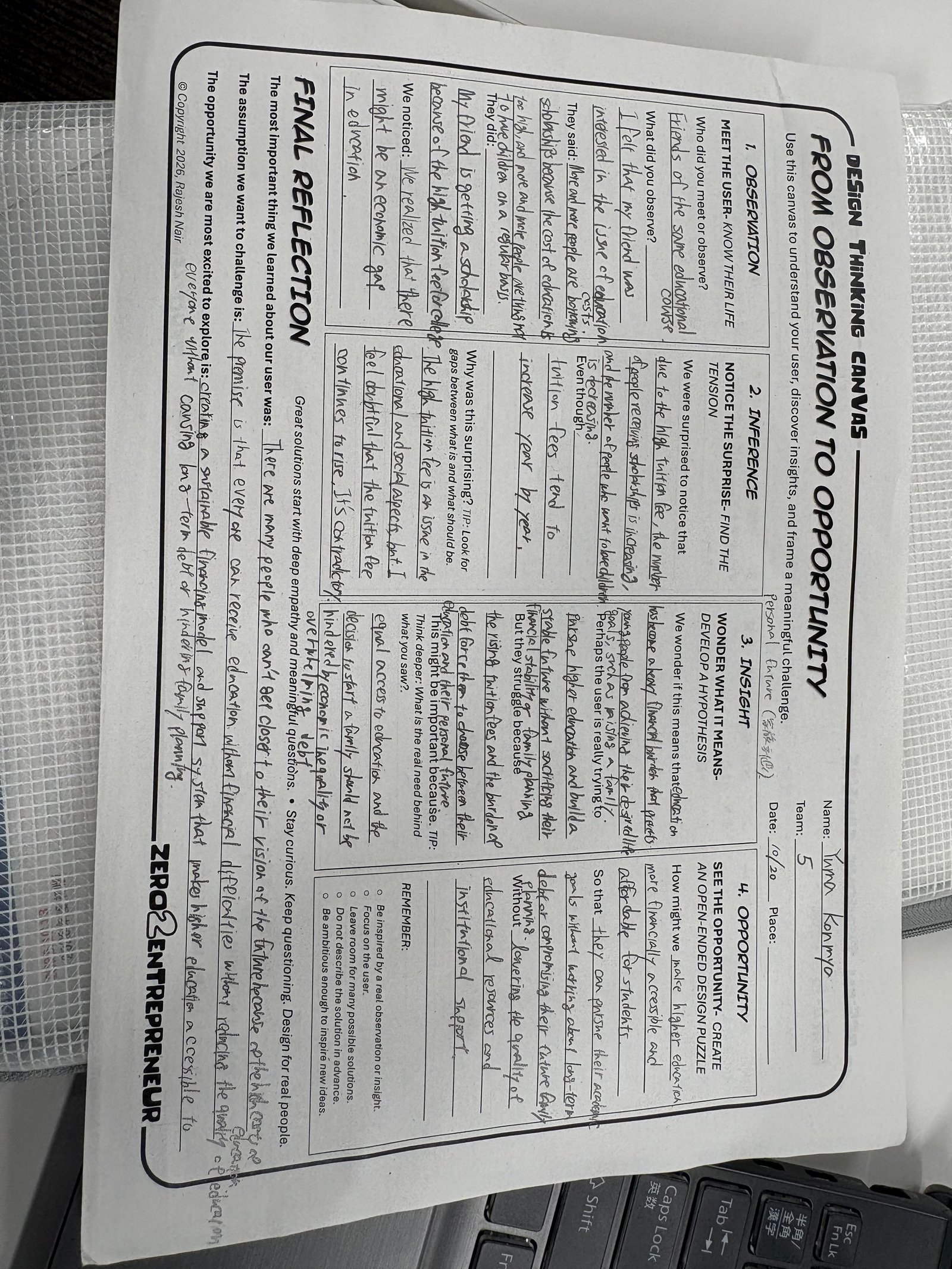
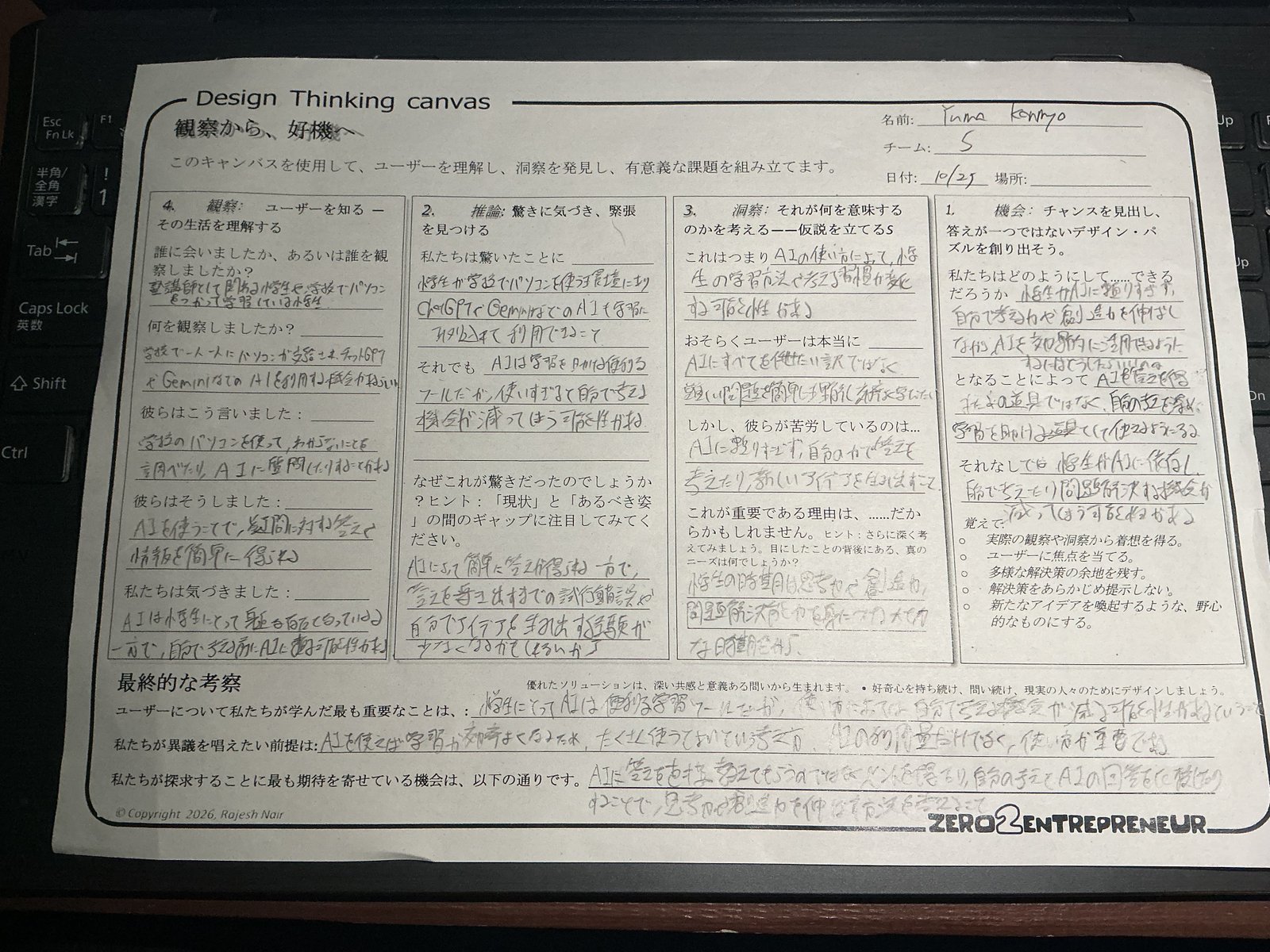
Fill in your Canvas with your observations and insights. Summarize what you added, and include a canvas link or photo.
Our team discussed how excessive AI use may affect the thinking skills and creativity of elementary school students. I work as a tutor and interact with elementary school students. Through my experience, I have heard that students are provided with their own computers at school and have opportunities to use generative AI tools such as ChatGPT and Gemini. This made me realize that AI is becoming a familiar part of children's learning environments and that its influence on their education is an important issue to consider.
First, we identified several benefits of AI. For example, students can ask questions whenever they need help, receive simple explanations of difficult topics, and discover new ideas. However, we also recognized that if students depend too much on AI, they may have fewer opportunities to think independently, learn from mistakes, and find solutions by themselves. For example, if students immediately ask AI for answers to their homework or ask it to create their school projects, they may miss important opportunities to develop their own ideas and problem-solving skills.
Elementary school is an important stage in children's development because they are learning how to think critically, use their imagination, and solve problems in different ways. Therefore, we believe that the main issue is not the use of AI itself, but how children use it. Instead of asking AI for answers immediately, students could try to solve problems by themselves first and then compare their ideas with the AI's responses. They could also ask AI for hints rather than complete answers. These methods may help children use AI as a learning tool while continuing to develop their own thinking skills and creativity.
In our Canvas, we organized the main target group as elementary school students and identified the main problem as the possible negative effects of excessive dependence on AI on the development of thinking skills and creativity. We also considered situations in which children might use AI, such as doing homework, preparing school projects, writing essays, and answering everyday questions. In addition, we identified several questions that need further investigation. For example, when and why do children depend on AI? How does the way they use AI affect their learning habits? What can parents and teachers do to encourage appropriate AI use?
Our goal is not to completely prohibit children from using AI. Instead, we want to explore ways to help children use AI effectively without losing opportunities to think independently, develop their imagination, and solve problems on their own. By finding a balance between AI assistance and independent thinking, we hope to create a better learning environment for elementary school students.