
Loading...
KAWAMURA Saki
Zero2Entrepreneur Portfolio

KAWAMURA Saki

Contribution activity

10 contributions in the last year

Submissions, reviews, and documented work

Nov Dec Jan Feb Mar Apr May Jun Jul Aug Sep Oct Nov
Mon Wed Fri
Less More

About Me

河村 咲希 · Faculty of Engineering — Electrical & Electronic Engineering · 工 工 電気電子工学 · Year 1

4
Submissions
4
Evaluations
1
Fully reviewed
4.3
Avg score

Course submissions

Every submitted session, with the date it was turned in and when it was evaluated.

Session Work Date submitted Evaluation date Reviews
Session 1 Name Problem Prediction Oct 1, 2026 Oct 6, 2026 → Oct 21, 2026 2/2 avg 5
Session 2 Field Notes & Empathy Canvas Oct 20, 2026 Oct 27, 2026 1/2 avg 4
Session 3 Subculture: Problem Statement & Canvas Oct 27, 2026 Nov 17, 2026 1/2 avg 4
Session 4 Solution & 6-Slide Pitch Nov 10, 2026 Pending 0/2
Session 1

Name Problem Prediction

Reviews complete
Date submitted
Oct 1, 2026 5:30 AM UTC
Evaluation date
Oct 6, 2026 → Oct 21, 2026
Peer reviews
2 of 2 · avg 5/5
What do you predict, and why?

I predict that students will prioritize appearing to understand a subject over understanding it deeply, changing their purpose in learning. I focused on three news articles. On September 9, 2026, TBS CROSS DIG with Bloomberg reported a study in which AI use improved homework scores but lowered exam scores [1]. On September 23, Korea JoongAng Daily reported that South Korean universities were recommending in-person exams and other measures to prevent AI-assisted cheating [2]. On September 2, Chalkbeat reported that teachers were struggling to address cheating. It also described assessment methods involving oral explanations and reviews of how students revised their work [3]. These reports suggest that finished assignments alone are becoming less reliable evidence of students’ understanding. Schools will therefore increasingly ask students to explain how they reached their answers. However, if these explanations strongly influence grades, students may spend more effort preparing explanations that earn high marks than reviewing what they do not understand. The purpose of asking for explanations is to check students’ understanding. But if polishing explanations becomes a goal in itself, developing a deeper understanding may become a lower priority. For this reason, I predict that assessments intended to check understanding could encourage students to focus on appearances and change their purpose in learning. References [1] TBS CROSS DIG with Bloomberg. (2026, September 9). AI多用の生徒はテスト成績低い傾向、OECDが頼り過ぎに警鐘 [Students who frequently use AI tend to have lower test scores; OECD warns against overreliance]. https://newsdig.tbs.co.jp/articles/withbloomberg/2932901?display=1 [2] Korea JoongAng Daily. (2026, September 23). Universities set up guardrails to confront growing AI dependence. https://www.koreajoongangdaily.com/korea/universities-set-up-guardrails-to-confront-growing-ai-dependence/12889775 [3] Chalkbeat. (2026, September 2). States urge schools to use AI, but leave teachers on their own to stop cheating. https://www.chalkbeat.org/2026/09/02/state-ai-guidance-schools-skirts-cheating-teachers/
Evaluations
Review 1 · 5/5
Oct 6, 2026 10:31 AM UTC
Review 2 · 5/5
Oct 21, 2026 12:09 AM UTC
Session 2

Field Notes & Empathy Canvas

Awaiting reviews
Date submitted
Oct 20, 2026 8:29 AM UTC
Evaluation date
Oct 27, 2026
Peer reviews
1 of 2 · avg 4/5
Interview three more people about challenges with the education system. Write what you heard (facts and statements), not your interpretation.

Person 1:In high school, the first person had to memorize a lot of information for exams. However, they said that they often forgot most of what they had learned after the exams were over. Person 2:The second person said that some lessons were difficult to understand. However, they felt uncomfortable asking questions because other students rarely asked questions in class. Person 3:The third person said that educational opportunities depend on where people grow up and their family backgrounds. For example, urban areas often have more educational facilities, such as cram schools and museums, while rural areas have fewer opportunities. They also mentioned that family income can affect whether students can attend cram schools or private schools. They believed that these differences create unequal educational opportunities.

Fill your Lucid frame for your team with observations. Describe what you added, and include the Lucid link if you have one.

I added observations from interviews about challenges in the education system to our team's Lucid frame. One observation was that students often memorize information for exams but forget much of it afterward.

Identify one problem from your engagements. Who is facing what challenge, and why does it matter?

Many students focus on memorizing information to pass exams rather than understanding it deeply. As a result, they often forget what they learned after the exams. This is a problem because students may not be able to use their knowledge in the future.

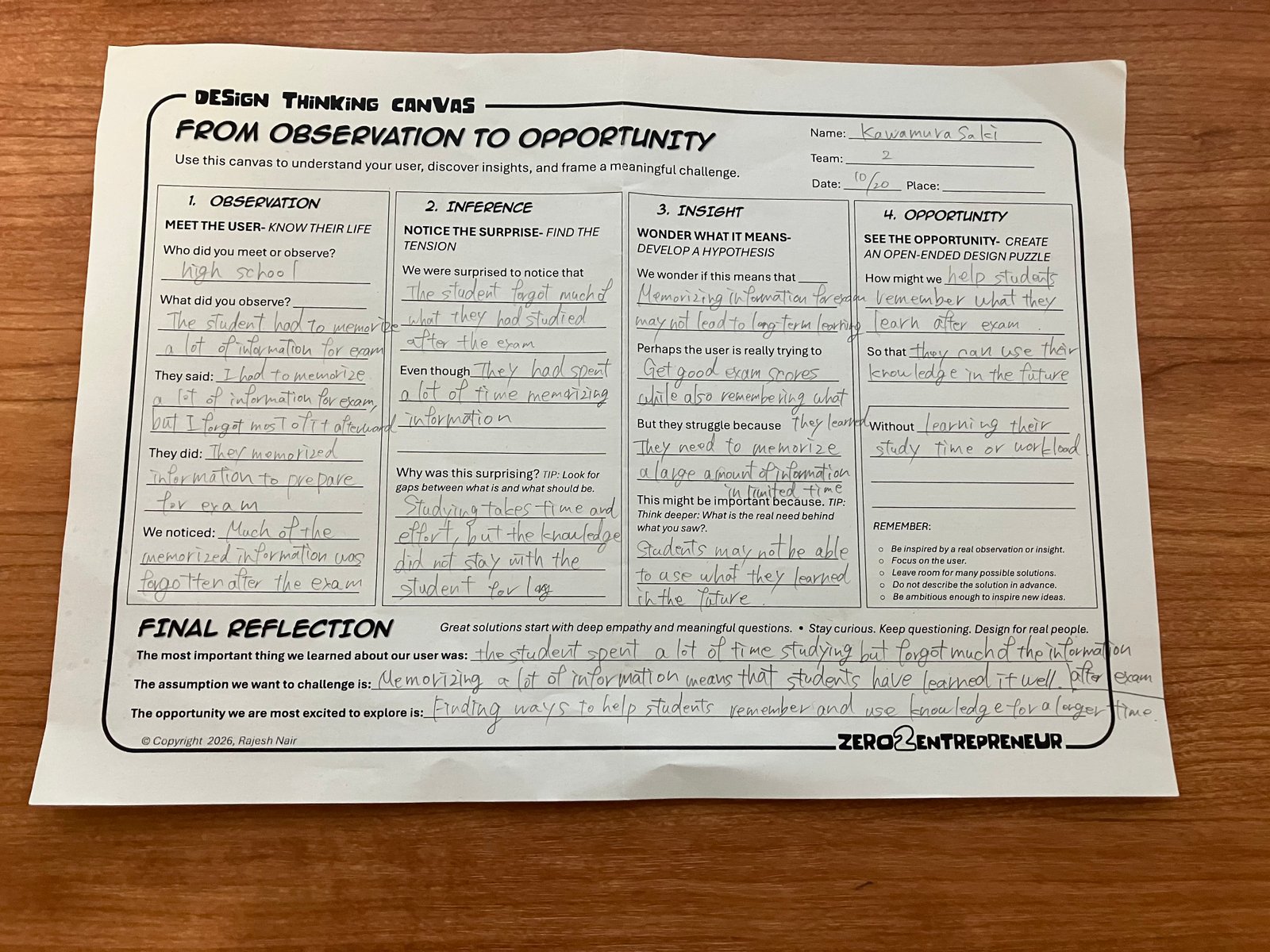
Fill out the Empathy Canvas. Summarize it here and add a photo or link to the canvas.

I completed the Design Thinking Canvas about students who forget what they learned after exams. Through the interview, I learned that students often memorize a lot of information for exams but forget much of it afterward. This suggests that memorization does not always lead to long-term learning. I identified an opportunity to help students remember and use what they learn without increasing their study time.

Evaluations
Review 1 · 4.8/5
Oct 27, 2026 5:54 AM UTC
Session 3

Subculture: Problem Statement & Canvas

Awaiting reviews
Date submitted
Oct 27, 2026 7:23 AM UTC
Evaluation date
Nov 17, 2026
Peer reviews
1 of 2 · avg 4/5
Discuss with your team and finalize the problem statement. Write the statement clearly: who is facing what challenge, in what situation, and why it matters.

Who: Students attending a class Situation: When they encounter something they do not understand during a lesson Problem: They feel too embarrassed to ask the teacher a question Why it matters: Because they remain unable to resolve their questions, which hinders their understanding of the lesson material

Fill in your Canvas with your observations and insights. Summarize what you added, and include a canvas link or photo.

Reasons why these issues might arise: ・The question is perceived as too simple, or asking it feels embarrassing. ・There is a reluctance to interrupt the lesson or cut off the teacher’s explanation. ・The pace of the lesson is too fast, leaving no opportunity to ask questions.

Evaluations
Review 1 · 4.5/5
Nov 17, 2026 9:17 AM UTC
Session 4

Solution & 6-Slide Pitch

Awaiting reviews
Date submitted
Nov 10, 2026 4:24 AM UTC
Evaluation date
Pending
Peer reviews
0 of 2
Discuss with your team and finalize the Solution. Write the solution clearly: what you will do, for whom, and why this approach.

We propose a system to help students who have questions but find it difficult to ask them during class. First, teachers will give short quizzes in every class, including a section where students can write comments and questions. Students will also have opportunities to explain what they have learned to each other and identify what they do not understand. In addition, students' questions will be shared with other students, who will research and answer them. We chose this approach because it can reduce students' fear of asking questions and help them identify what they do not understand. It also allows teachers to check students' understanding and helps students organize their knowledge and deepen their understanding.

Create a 6-slide pitch covering: Your Team, Problem Definition, Problem Analysis (What, Why, Who, When, and How), and Solution Approach. Summarize the slides here.

Our team focused on the problem of students finding it difficult to ask teachers questions during class. First, we defined the problem as students having questions but hesitating to raise their hands. Through our analysis, we identified several reasons, such as fear of asking irrelevant questions, concern about how others see them, and not wanting to interrupt the class. To solve these problems, we proposed including a section for questions in short quizzes given in every class. We also suggested activities where students explain what they have learned to each other, share questions, and research answers. Through these activities, we aim to reduce students' anxiety about asking questions and create an environment where they can identify their own questions and deepen their understanding.

Submit a link to your Google Slides file. Paste the shareable link, and make sure anyone with the link can view it.

https://docs.google.com/presentation/d/1ljPDhEooCqTZuSVsQGAKm-iYDR_HzIpkI_azrJEo9lY/edit?slide=id.p#slide=id.p

https://docs.google.com/presentation/d/1ljPDhEooCqTZuSVsQGAKm-iYDR_HzIpkI_azrJEo9lY/edit?slide=id.p#slide=id.p