
Loading...
KAGEURA Yuichi
Zero2Entrepreneur Portfolio

KAGEURA Yuichi

Contribution activity

8 contributions in the last year

Submissions, reviews, and documented work

Nov Dec Jan Feb Mar Apr May Jun Jul Aug Sep Oct Nov
Mon Wed Fri
Less More

About Me

影浦 悠一 · Faculty of Engineering — Mechanical Engineering · 工 工 機械工学 · Year 1 元気いっぱいで頑張ります。

3
Submissions
5
Evaluations
2
Fully reviewed
4.7
Avg score

Course submissions

Every submitted session, with the date it was turned in and when it was evaluated.

Session Work Date submitted Evaluation date Reviews
Session 1 Name Problem Prediction Sep 30, 2026 Oct 6, 2026 → Oct 19, 2026 2/2 avg 4
Session 2 Field Notes & Empathy Canvas Oct 20, 2026 Nov 4, 2026 → Nov 10, 2026 2/2 avg 5
Session 4 Solution & 6-Slide Pitch Nov 10, 2026 Nov 10, 2026 1/2 avg 5
Session 1

Name Problem Prediction

Reviews complete
Date submitted
Sep 30, 2026 9:29 AM UTC
Evaluation date
Oct 6, 2026 → Oct 19, 2026
Peer reviews
2 of 2 · avg 4/5
What do you predict, and why?

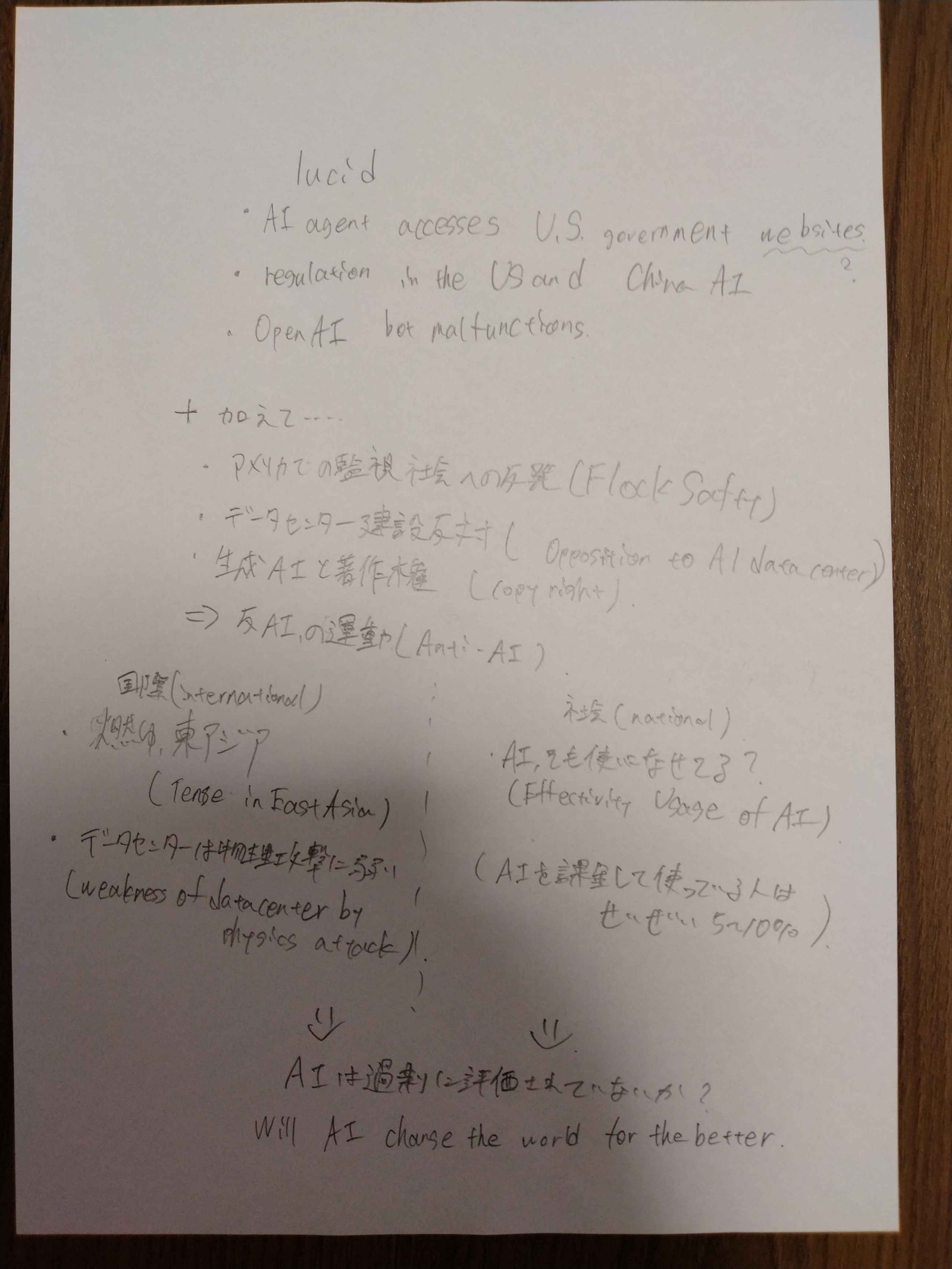
The AI Industry Built on Sand I will make a bold prediction: AI may not be able to change the world as much as we think it will. There are several reasons for this. First and foremost, as Sam Altman himself has pointed out, society has a great deal of inertia. AI may be highly capable, but some people do not know how to use it effectively, while others deliberately choose not to use it at all. In other words, AI may have a much harder time spreading throughout society than many people expect. Recently, we have also begun to hear the term “anti-AI” more often. In the United States, there has been opposition to the construction of data centers, as well as an incident in which a Molotov cocktail was thrown at Sam Altman’s home. In Japan, where industries such as anime and video games have a particularly strong cultural presence, there has also been fierce opposition to AI over concerns that it infringes on the rights of voice actors, illustrators, and other creators. Around 75% of the semiconductors that support the AI industry are supplied by East Asia. Yet East Asia is currently surrounded by geopolitical tensions. In South Korea, a North Korean landmine exploded in the Demilitarized Zone, injuring three people. The issue surrounding Taiwan has also grown beyond a dispute involving only Taiwan, China and Japan, increasingly drawing in the United States and countries across Southeast Asia. Meanwhile, during Iranian attacks in the Middle East, multiple data centers were targeted, and AWS ultimately gave up on restoring some of its affected infrastructure. What I want to point out is that companies may not have developed effective ways to protect themselves against risks such as anti-AI movements and geopolitical instability. I therefore believe that the current AI market may be overvalued. My prediction is that AI will change the world less than many people expect—or, at the very least, that it will not necessarily change the world for the better. https://www.zerohedge.com/ai/great-walkback-sam-altman-admits-he-was-wrong-ais-economic-timeline https://www.bcg.com/publications/2021/strengthening-the-global-semiconductor-supply-chain?utm_source=chatgpt.com https://www.washingtonpost.com/technology/2026/04/14/altman-home-attack-ai-division/?utm_source=chatgpt.com https://cafe-dc.com/cloud/aws-unable-to-restore-access-to-data-centers-hit-by-iran-strikes/ https://en.wikipedia.org/wiki/Opposition_to_AI_data_centers https://mikissh.com/diary/flock-cameras-mass-surveillance-in-us/
Evaluations
Review 1 · 5/5
Oct 6, 2026 10:30 AM UTC
Review 2 · 3.8/5
Oct 19, 2026 12:17 PM UTC
Session 2

Field Notes & Empathy Canvas

Reviews complete
Date submitted
Oct 20, 2026 6:44 AM UTC
Evaluation date
Nov 4, 2026 → Nov 10, 2026
Peer reviews
2 of 2 · avg 5/5
Interview three more people about challenges with the education system. Write what you heard (facts and statements), not your interpretation.

1. **Differences in learning levels:** Children have different learning abilities, needs, and levels of understanding. This makes it difficult for teachers to provide appropriate education for each individual student. 2. **Classroom disruption:** Some children have difficulty staying seated or remaining quiet during lessons. As a result, classes cannot proceed smoothly, and sometimes teaching becomes almost impossible. In Japan, there is a term for this phenomenon: "Gakkyu Hokai" (classroom breakdown). 3. **Bullying:** Bullying is a serious problem in schools. Adults often do not pay enough attention to what is happening among children, and some teachers are not even willing to address or resolve bullying problems.

Fill your Lucid frame for your team with observations. Describe what you added, and include the Lucid link if you have one.

Schools provide opportunities to make friends, meet different people, and learn new things. Students enjoy club activities, school events, and interacting with teachers. Some students appreciate the facilities, convenient locations, and affordable tuition. Students face heavy workloads, long classes, and pressure from exams and assignments. The quality of education varies depending on the teacher. Bullying, classroom disruption, and strict school rules can negatively affect students. Teachers have heavy workloads and may struggle to support individual students. Some students are concerned about educational inequality and the impact of new technologies, including AI.

Identify one problem from your engagements. Who is facing what challenge, and why does it matter?

Teachers face challenges in providing appropriate education for every student because children have different learning abilities and needs. Some students also have difficulty staying quiet or seated during lessons, making classroom management difficult. This matters because these problems can prevent students from receiving a good education and negatively affect their learning and development.

Fill out the Empathy Canvas. Summarize it here and add a photo or link to the canvas.

https://docs.google.com/presentation/d/1TcCvn227zFXZ37XtrfpApMl_KsWivlErBSkMRmhutDA/edit?slide=id.p#slide=id.p

Evaluations
Review 1 · 5/5
Nov 4, 2026 1:12 PM UTC
Review 2 · 5/5
Nov 10, 2026 8:36 AM UTC
Session 4

Solution & 6-Slide Pitch

Awaiting reviews
Date submitted
Nov 10, 2026 8:48 AM UTC
Evaluation date
Nov 10, 2026
Peer reviews
1 of 2 · avg 5/5
Discuss with your team and finalize the Solution. Write the solution clearly: what you will do, for whom, and why this approach.

We came up with some solutions to the problem of students not asking enough questions in class. Our ideas include giving short quizzes, collecting questions anonymously, and having students explain what they have learned to each other. By explaining things in their own words, students can make new discoveries, find gaps in their understanding, and come up with new questions. We also believe these activities can help teachers better understand how well their students understand the lessons.

Create a 6-slide pitch covering: Your Team, Problem Definition, Problem Analysis (What, Why, Who, When, and How), and Solution Approach. Summarize the slides here.

We tried to make our slides clear and easy to understand. We spent a lot of time discussing our ideas with our team members. In the end, our discussions focused on one main question: "What makes education more effective?" We first thought about how to make classes better, and then tried to find a solution to the problem of students not asking questions.

Submit a link to your Google Slides file. Paste the shareable link, and make sure anyone with the link can view it.

https://docs.google.com/presentation/d/1ljPDhEooCqTZuSVsQGAKm-iYDR_HzIpkI_azrJEo9lY/edit?slide=id.h5da9fc9777187b0_0_22#slide=id.h5da9fc9777187b0_0_22

Evaluations
Review 1 · 5/5
Nov 10, 2026 9:25 AM UTC